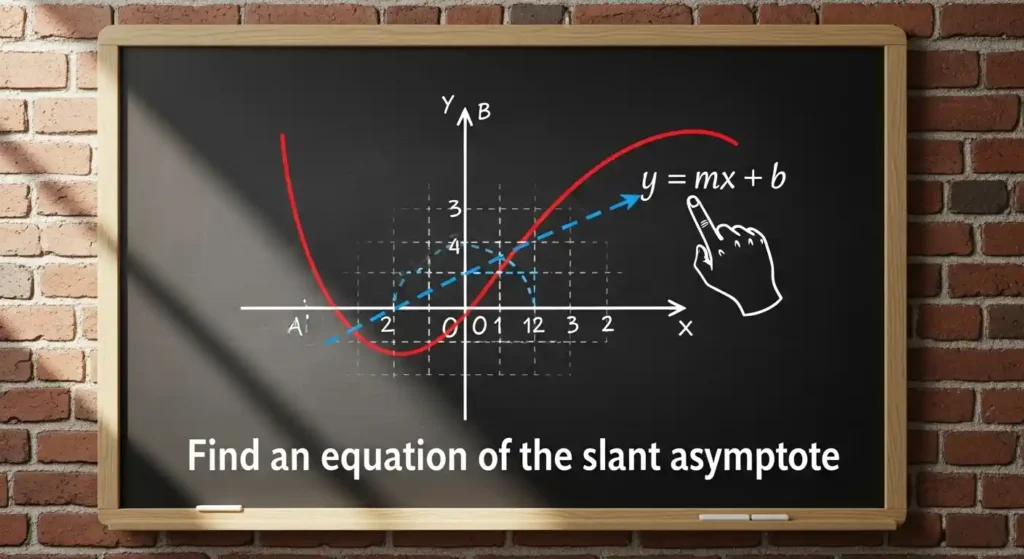
If you’ve ever graphed a rational function and noticed the curve chasing a diagonal line without ever touching it, you’ve already seen a slant asymptote in action. Knowing how to find an equation of the slant asymptote is one of those skills that seems intimidating at first but clicks almost instantly once you see the pattern. Whether you’re prepping for a calculus exam or just trying to make sense of your homework, this guide walks you through the whole process without the textbook jargon.
When Does a Slant Asymptote Actually Exist?
Not every rational function has a slant asymptote. Before you start dividing polynomials, check this condition first.
A slant (also called oblique) asymptote exists when the degree of the numerator is exactly one more than the degree of the denominator.
Here’s the quick rule:
- Degree of numerator = Degree of denominator → horizontal asymptote
- Degree of numerator < Degree of denominator → horizontal asymptote at y = 0
- Degree of numerator = Degree of denominator + 1 → slant asymptote
- Degree of numerator > Degree of denominator by 2 or more → no asymptote (curved end behavior)
So if you have something like (x² + 3x + 1) / (x + 2), you’re in slant asymptote territory because the numerator has degree 2 and the denominator has degree 1.
How to Find an Equation of the Slant Asymptote Using Polynomial Long Division
This is the main method, and honestly, it’s straightforward once you practice it a couple of times.
Step 1: Set Up the Division
Take your rational function and divide the numerator by the denominator using polynomial long division. Ignore the remainder — that’s the key step most people miss.
Step 2: Perform the Division
Let’s work through a real example.
Find the slant asymptote of f(x) = (x² + 5x + 6) / (x + 2)
Divide x² + 5x + 6 by x + 2:
- x² ÷ x = x → multiply: x(x + 2) = x² + 2x → subtract: (x² + 5x + 6) − (x² + 2x) = 3x + 6
- 3x ÷ x = 3 → multiply: 3(x + 2) = 3x + 6 → subtract: (3x + 6) − (3x + 6) = 0
Result: x + 3 (with a remainder of 0)
So the slant asymptote is y = x + 3.
Step 3: Drop the Remainder
Even when the remainder isn’t zero, you still drop it. The asymptote is only the quotient — the non-fractional part of your answer.
Example with a remainder:
f(x) = (2x² + 3x − 5) / (x − 1)
Divide 2x² + 3x − 5 by x − 1:
- 2x² ÷ x = 2x → multiply: 2x(x − 1) = 2x² − 2x → subtract: 5x − 5
- 5x ÷ x = 5 → multiply: 5(x − 1) = 5x − 5 → subtract: 0
Quotient: 2x + 5, remainder: 0
Slant asymptote: y = 2x + 5
Tractor Supply Job Description: Roles, Pay and Tips
Using Synthetic Division as a Shortcut
If the denominator is a linear binomial of the form (x − c), synthetic division gets you to the answer faster.
When to Use It
Synthetic division works when the denominator is exactly (x − c) — like (x − 3), (x + 1), or (x − 7). If the denominator is quadratic or more complex, stick with long division.
Quick Example
f(x) = (3x² − 2x + 4) / (x − 2)
Use synthetic division with c = 2 and coefficients 3, −2, 4:
- Bring down 3
- 3 × 2 = 6 → −2 + 6 = 4
- 4 × 2 = 8 → 4 + 8 = 12
Quotient: 3x + 4, remainder: 12
Slant asymptote: y = 3x + 4
The remainder 12 gets ignored — it shrinks to zero as x approaches infinity, which is exactly why it doesn’t affect the asymptote.
Pros and Cons of Each Method
Polynomial Long Division
- ✅ Works for any rational function
- ✅ Reliable and consistent
- ❌ Slower and more steps involved
- ❌ Easy to make arithmetic errors in multi-step subtraction
Synthetic Division
- ✅ Much faster for linear denominators
- ✅ Fewer steps, less chance of sign errors
- ❌ Only works when denominator is (x − c)
- ❌ Can’t handle quadratic or higher-degree denominators
Common Mistakes to Avoid
People trip up on slant asymptotes in the same ways repeatedly. Watch out for these:
1. Forgetting to check the degree condition first Jumping straight into division without confirming the numerator’s degree is exactly one more than the denominator will waste your time — or worse, give you a wrong answer you believe is right.
2. Including the remainder in the asymptote equation The remainder term approaches zero as x → ±∞. It is not part of the asymptote. Write only the quotient.
3. Confusing slant asymptotes with horizontal ones If degrees are equal, you get a horizontal asymptote — not a slant one. Double-check before dividing.
4. Sign errors during subtraction Long division requires careful subtraction at each step. A sign flip early in the process throws off everything that follows. Write each step clearly rather than doing it in your head.
5. Forgetting that the curve never touches the asymptote Well, technically it can cross a slant asymptote at a finite point — but for graphing purposes, the end behavior follows the asymptote line. Don’t assume the function is restricted from crossing it near the origin.
Best Practices for Finding Slant Asymptotes
- Always verify degree conditions before attempting division. Save yourself the work.
- Show all division steps in your work, especially on exams. Partial credit depends on it.
- Double-check your division by multiplying the quotient back by the divisor and comparing to the original numerator.
- Graph the function and the asymptote on the same axes to visually confirm your answer makes sense.
- Practice with remainders too. Many students only drill problems where remainders cancel out. Real exam questions won’t always be that clean.
Conclusion
Finding the equation of a slant asymptote comes down to one core technique: polynomial long division. Check that your numerator’s degree is exactly one higher than the denominator, divide carefully, and write only the quotient as your asymptote. Drop the remainder — it vanishes as x heads toward infinity anyway.
Once you’ve done it a few times, the process becomes almost automatic. The hard part isn’t the math itself — it’s remembering to check the degree condition first and resist the urge to include that leftover remainder. Stick to the steps, verify with a graph when you can, and you’ll handle slant asymptote problems with confidence.
Frequently Asked Questions
1. What is the difference between a slant asymptote and a horizontal asymptote?
A horizontal asymptote is a flat line (y = constant) that the function approaches as x goes to infinity. A slant asymptote is a diagonal line (y = mx + b, where m ≠ 0) that the function approaches. Slant asymptotes occur when the numerator’s degree is exactly one more than the denominator’s.
2. Can a rational function have both a slant and a horizontal asymptote?
No. A rational function can have one or the other, but not both. If a slant asymptote exists, there is no horizontal asymptote, and vice versa.
3. Does the curve ever cross a slant asymptote?
Yes, it can cross near the middle of the graph. An asymptote only describes end behavior — what happens as x → ±∞. Near finite values of x, the function can intersect the asymptote line.
4. Is synthetic division always faster than long division for slant asymptotes?
Synthetic division is faster, but only works when the denominator is a simple linear expression like (x − c). For anything more complex, long division is the reliable choice.
5. How do I verify my slant asymptote is correct?
Multiply your quotient back by the divisor and add the remainder. If the result equals the original numerator, your division was correct. You can also graph both the function and y = mx + b to check that the curve follows the line at the far ends.