Ever had to tell someone their work needs improvement — but you didn’t want to sound harsh? That’s exactly where sandwich method writing comes in. It’s one of the most practical and widely used feedback techniques in professional and academic settings, and once you understand how it works, you’ll never give feedback the same way again.
The idea is simple, but the impact is real.
What Is the Sandwich Method Writing Technique?
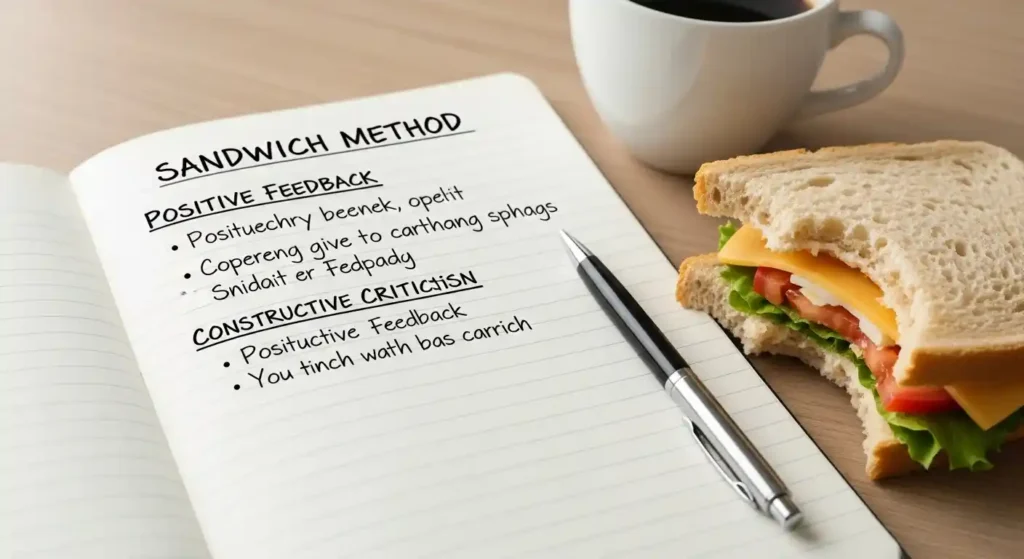
The sandwich method writing technique is a feedback structure where you place constructive criticism between two layers of positive comments — just like a filling between two slices of bread.
The three-part structure looks like this:
- Top slice (bread): Start with genuine praise
- Filling (meat): Deliver the constructive feedback or critique
- Bottom slice (bread): Close with encouragement or another positive note
It sounds almost too simple. But when applied correctly, it changes how feedback lands — and how people respond to it.
Why People Use This Method
Most people don’t like criticism, even when it’s helpful. The brain naturally responds to negative feedback with defensiveness. The sandwich approach softens that reaction by framing critique inside something positive.
Teachers use it in classrooms. Managers use it during performance reviews. Coaches use it on the field. It’s everywhere because it works across almost every setting where you need to deliver an honest but sensitive message.
The technique also encourages the person receiving feedback to stay open and actually process what you’re saying — rather than shutting down after the first hard comment.
How to Write a Proper Feedback Sandwich
Step 1: Lead With Something Real and Positive
Don’t make up praise just to soften the blow. People can feel empty compliments from a mile away, and it makes the whole thing feel manipulative.
Look for something genuinely good about the work, effort, or approach — and lead with that. Make it specific, not generic.
Weak: “Good job on this.” Strong: “Your opening paragraph immediately grabbed my attention — the hook was really effective.”
Specificity shows you actually paid attention. That earns trust before you move into the harder part.
Spring Crawfish: Your Complete Guide to the Season
Step 2: Deliver the Critique Clearly
This is the part most people fumble. They either bury the criticism so deep it gets missed, or they over-soften it until it loses all meaning.
Be direct. Be kind. But be clear.
Use language like:
- “One area to strengthen would be…”
- “I noticed the middle section loses focus — here’s how to fix that…”
- “The argument could be more convincing if…”
Avoid vague phrases like “maybe consider” or “just a thought” when you actually mean “this needs to change.” Unclear feedback helps no one.
Step 3: Close With Encouragement and Forward Motion
The final layer isn’t just about being nice — it’s about pointing forward. End with something that shows confidence in the person’s ability to improve and act on the feedback.
Example close: “Overall, you clearly understand the topic. With a tighter structure in the body paragraphs, this piece will be really strong.”
That closing gives them something to act on and reminds them that improvement is possible.
A Full Sandwich Method Example
Here’s what a complete feedback sandwich looks like in practice:
Situation: A colleague submits a report that has strong research but poor organization.
“The data you pulled together here is impressive — you clearly did thorough research, and the sources are credible and well-chosen. That said, the report is hard to follow because the sections jump around without clear transitions. Readers may lose the thread of your argument. If you restructure it with a brief summary at the top and cleaner transitions between sections, this will be one of the strongest reports we’ve submitted this quarter.”
Notice: the praise is specific, the critique is clear with a reason, and the closing is forward-looking without being fake.
Pros and Cons of the Sandwich Method
Pros
- Makes feedback easier to receive, especially for sensitive topics
- Reduces defensiveness and emotional shutdown
- Keeps the tone constructive rather than punishing
- Works well in both written and verbal communication
- Encourages ongoing dialogue between the giver and receiver
Cons
- Can feel formulaic if used too often with the same person
- Praise may seem insincere if it’s not specific enough
- The critique can get buried and lose its impact
- Not ideal for urgent or serious issues that need direct communication
- Some experienced professionals find it condescending
Common Mistakes People Make
Even with a good structure, people mess this up. Here are the most common mistakes to avoid:
1. Using hollow praise “Great work!” before a serious critique doesn’t fool anyone. Specific, earned praise is the only kind that works.
2. Making the critique too vague Saying “this needs work” tells someone nothing. Say what needs work and why.
3. Over-softening the middle If the core message gets lost in qualifiers and hedging, the feedback fails its purpose. The whole point of the sandwich is to make the critique easier to hear — not to hide it.
4. Ending too weakly A flat ending like “Anyway, good effort” doesn’t leave the person with anything useful. Close with energy and direction.
5. Using the same formula every single time People catch on. If every piece of feedback you give follows the exact same rhythm, it starts to feel mechanical and people stop trusting it.
Best Practices for Using This Technique Well
- Tailor your language to the person — formal for professional settings, warmer for personal or creative contexts
- Use it selectively, not for every single interaction
- Combine it with follow-up questions to encourage two-way conversation
- Write it out before delivering verbal feedback so you don’t lose the structure under pressure
- Adjust the ratio — sometimes two sentences of praise and four lines of critique is exactly right; don’t force balance that doesn’t fit
Conclusion
The sandwich method writing technique is one of those tools that looks simple on the surface but requires real skill to use well. Done right, it makes feedback something people can actually hear, process, and act on. Done wrong, it just creates noise.
The key is always authenticity. Specific praise, honest critique, and a forward-looking close — that combination works whether you’re editing a colleague’s email or giving a student feedback on an essay.
Use it with intention, adapt it to the moment, and you’ll find it becomes one of the most reliable tools in your communication toolkit.
FAQs
1. What is the sandwich method in writing?
It’s a feedback technique where constructive criticism is placed between two positive statements to make it easier for the recipient to receive and act on the critique.
2. When should I use the sandwich method?
It works best in one-on-one feedback situations — performance reviews, student writing feedback, creative collaboration, or any setting where you want to maintain a positive relationship while still being honest.
3. Is the sandwich method effective for all types of feedback?
Not always. For urgent issues, serious performance problems, or repeat behavior, a more direct approach is often better. The sandwich method works best for developmental, non-urgent feedback.
4. How do I avoid making the praise feel fake?
Be specific. Instead of “good job,” point to exactly what worked and why. Specificity signals that your praise is real, not just a formality.
5. Can the sandwich method be used in written communication?
Absolutely. It’s just as effective in emails, written evaluations, and feedback documents as it is in face-to-face conversations. The structure translates naturally to writing.